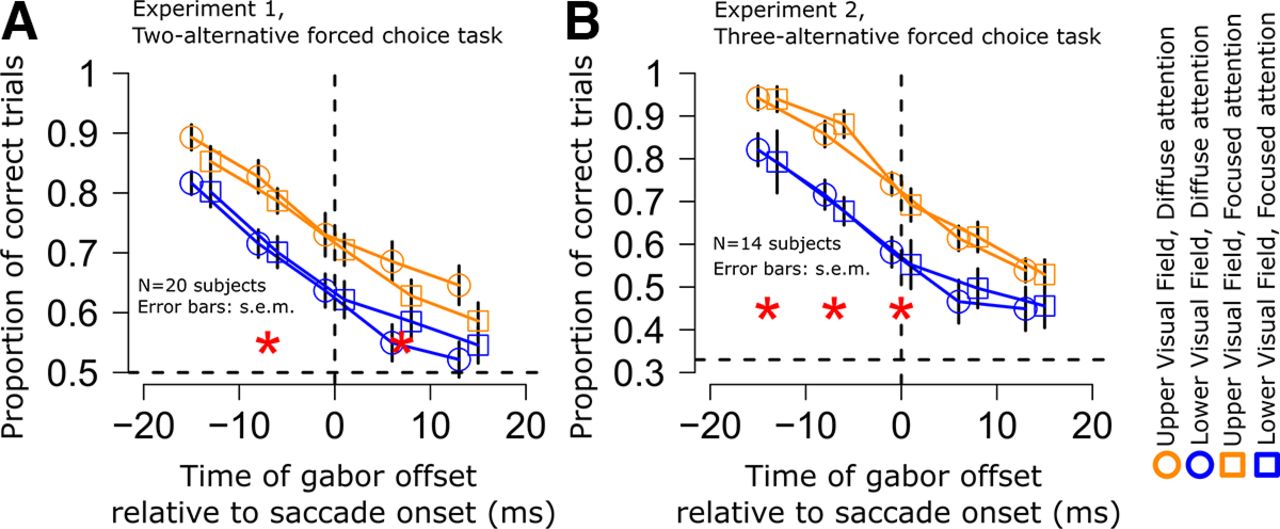
Similarity of peri-saccadic orientation identification performance between the focused and diffuse attention conditions in each experiment. A, Time course of orientation identification performance relative to saccade onset for targets in the upper (yellow) or lower (blue) visual field in experiment 1 (diffuse attention condition: circles; focused attention condition: squares; see Materials and Methods). Red asterisks indicate significant differences between upper and lower targets (GLMM, main effect of target gabor grating location, p < 0.01; error bars denote SEM). B, Similar analysis for experiment 2. Here, chance performance was at 0.33 proportion of correct trials, instead of 0.5 (see dashed horizontal line). In both cases, peri-saccadic perceptual performance was significantly higher in the upper rather than the lower visual field. It is important to note that within each experiment, the effect size for the focused and diffuse attention conditions was similar, and no interaction between target location and attention condition was observed.


