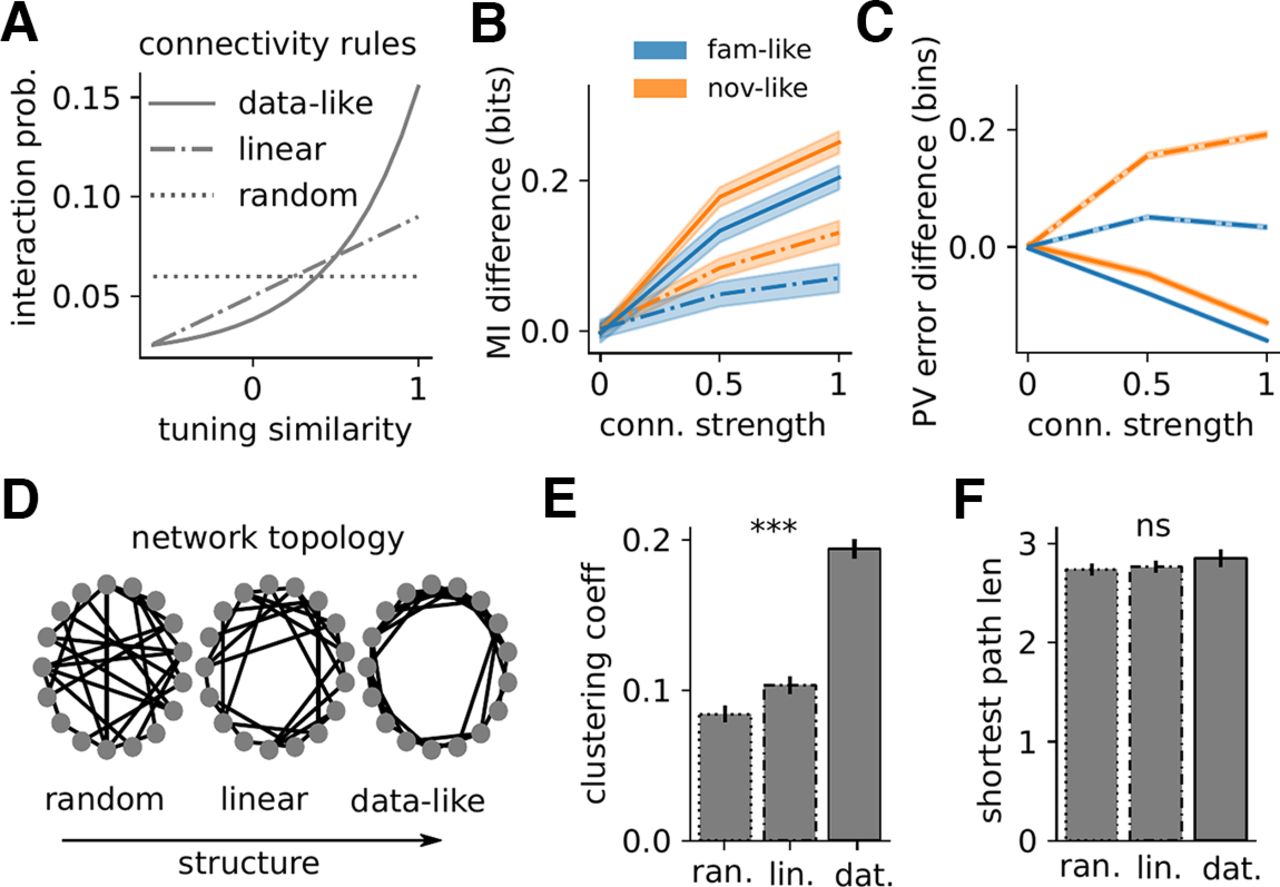
Data-like interaction pattern is sufficient to generate small-world networks with improved spatial coding. A, Connectivity rules for positive connections in a simulated place cell network with 50 units. B, Mutual information (MI) increase for data-like (solid) and linear (dashed) connectivity rule relative to the random connectivity, for familiar-like (blue) and novel-like (orange) quality input. Shaded areas show the 95th percentile confidence interval for the mean. C, Average decoding error increase for data-like (solid) and linear (dashed) connectivity rule relative to random connectivity. Error measured as distance between real and decoded spatial bin. D, Example network topologies obtained by using different connectivity rules from A. Nearby nodes have high tuning similarity. E, Average clustering coefficient for the three connectivity rules from A (error bars, SE; significance, one-way ANOVA test, ***p < 0.001 for or n.s. for p > 0.05). F, Average shortest path length for the three connectivity rules from A. See Extended Data Figure 5-1 for more information.


