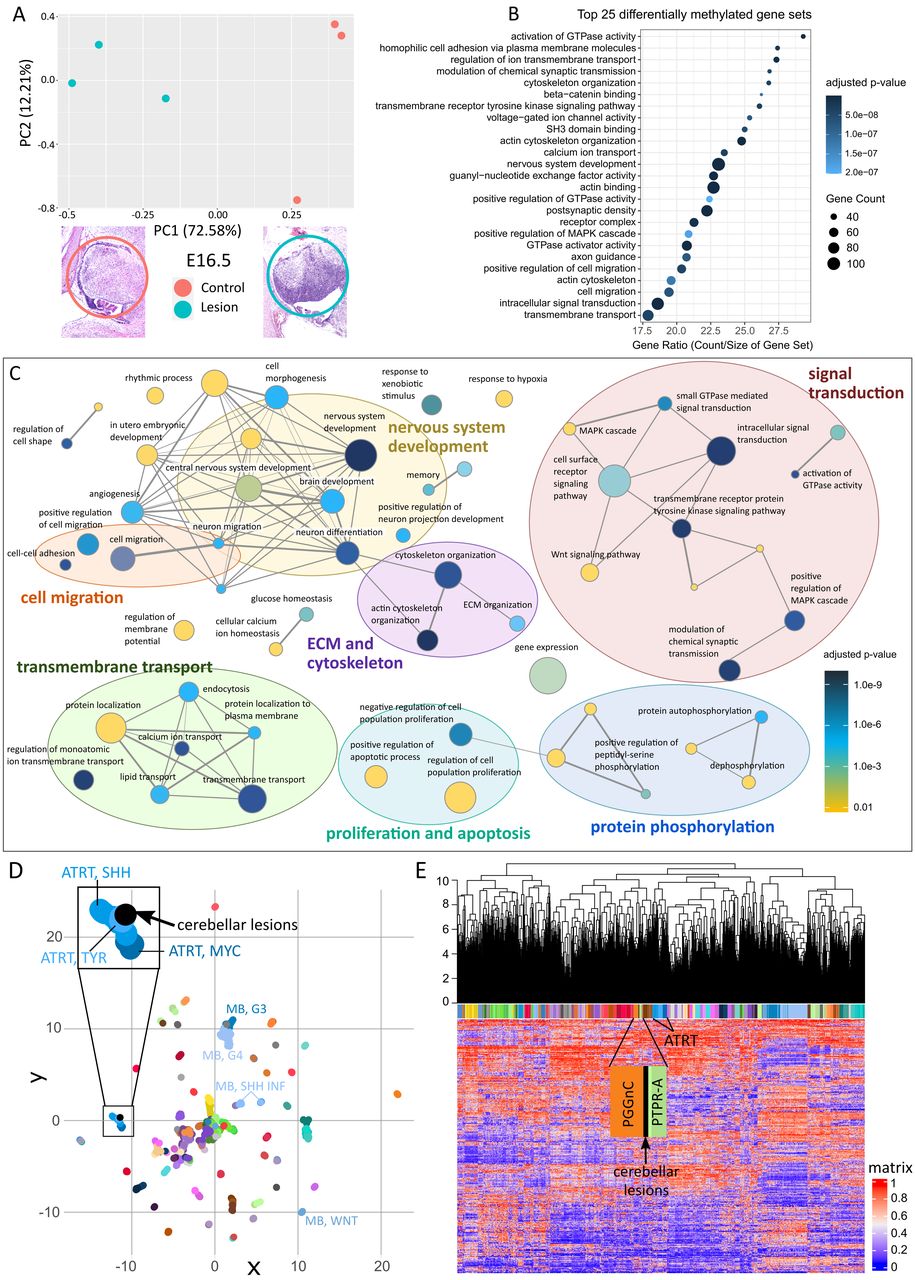
DNA methylation analysis of cerebellar lesions at E16.5. A, E16.5 control cerebella and lesions of Blbp-cre::Ctnnb1(ex3)fl/wt::Smarca4fl/rec mutants can be clearly separated according to 10,000 most differentially methylated CpG sites in PCA analysis. Recombined alleles of Smarca4 and Ctnnb1 in the cerebellar DNA of mutants were confirmed by PCR. B, Top 25 differentially methylated gene sets between controls and lesions according to adjusted p-value (methylRRA was applied; Ren and Kuan, 2019) sorted by gene ratio (count/size of gene sets). C, All significantly differentially methylated gene sets of the category “biological process” found with methylRRA were summarized by REVIGO to remove redundant terms (Supek et al., 2011). Here, 3% of the strongest GO terms pairwise similarities are designated as edges in the graph. The size of bubbles corresponds to the size of gene sets. D, UMAP embedding according to DNA methylation of cerebellar lesions of Blbp-cre::Ctnnb1(ex3)fl/wt::Smarca4fl/rec mice at E16.5 (Mouse Methylation BeadChip, Illumina) and human brain tumors (Capper et al., 2018; Sharma et al., 2019; in-house analyzed samples, total n = 1,683) using 491 orthologous CpG sites out of the 15,000 most differentially methylated CpG sites within the human dataset. Mouse samples show the most similarity to ATRT subgroups. E, Heatmap clustering according to DNA methylation of the same samples and CpG sites shows the proximity of cerebellar lesions to PGGnC [paraganglional, spinal non-CIMP (CpG island methylator phenotype)] and PTPR-A (papillary tumor of the pineal region, group A). MB, G3 = Group 3 MB; MB, G4 = Group 4 MB; MB SHH INF = infant SHH MB; ATRT, TYR = ATRT of the tyrosine kinase subgroup; ATRT, MYC = ATRT of the MYC subgroup; ATRT, SHH = ATRT of the SHH subgroup.


