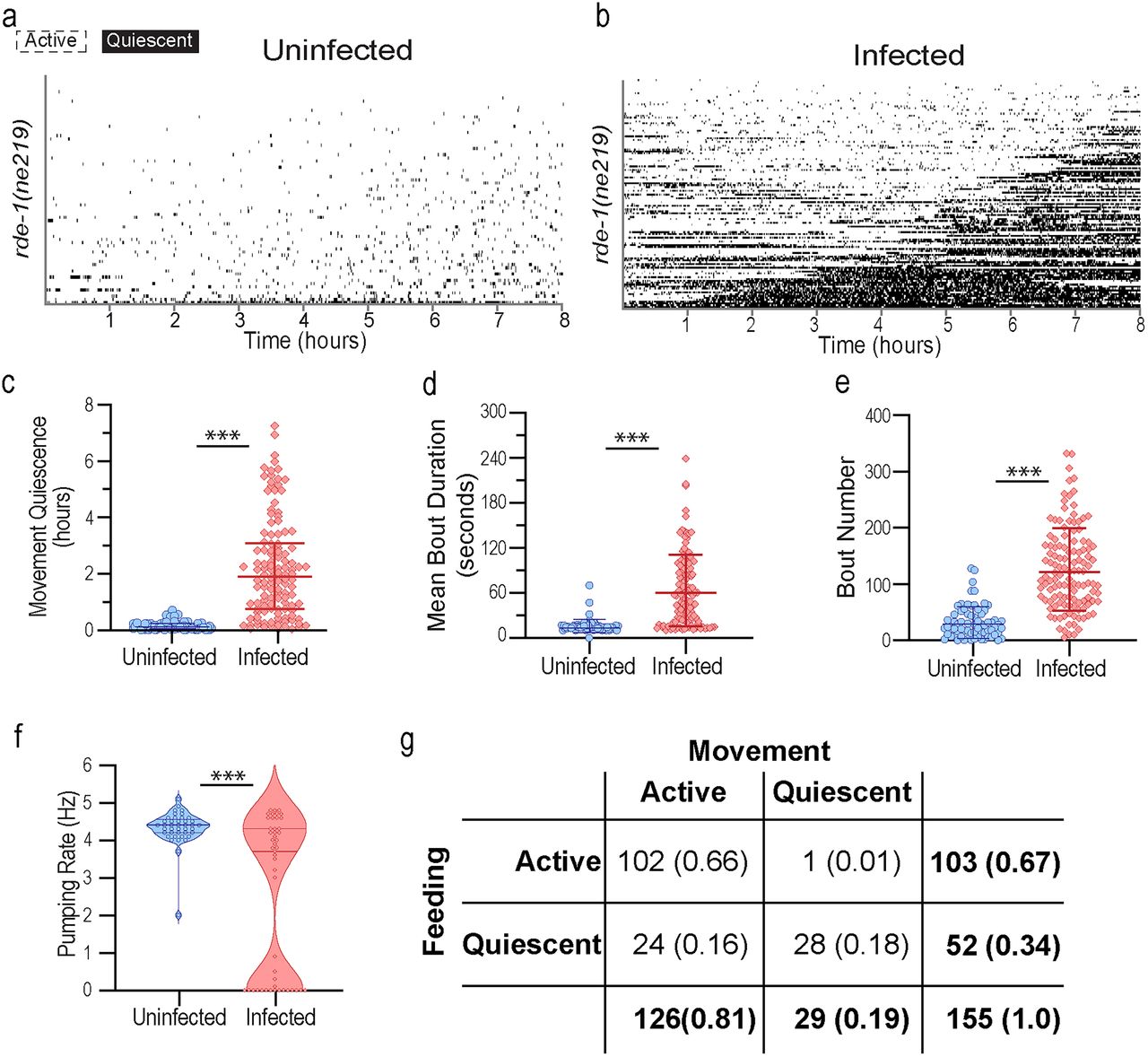
Orsay virus infection induces a sleep state in C. elegans rde-1 mutants. a, b, Activity and quiescence over 8 h of individual Day 1 adult rde-1 worms uninfected (a, n = 73) or infected (b, n = 122). Each row represents an individual worm. White indicates movement and black indicates quiescence. Data are ordered from least quiescent (top) to most quiescent (bottom). Data are pooled from 12 WorMotels. c, Total time spent quiescent during the 8 h period shown in Figure 1a,b. Mean ± standard deviation. d, e, Mean bout duration (d) and number of bouts (e) related to movement quiescence bouts from data in a–c. Mean ± standard deviation. f, Feeding rate during a 10 s period: uninfected (n = 41) or infected (n = 47) rde-1 worms. Solid horizontal lines indicate medians, and dotted lines indicate first and third quartiles. g, Co-occurrence of movement and feeding quiescence, frequency table (with fraction of whole in parentheses). Movement and feeding quiescence are not independently occurring behavioral states (Χ2(1) = 63.52; p < 0.0001). ***p < 0.001, two-tailed Student's t test.


