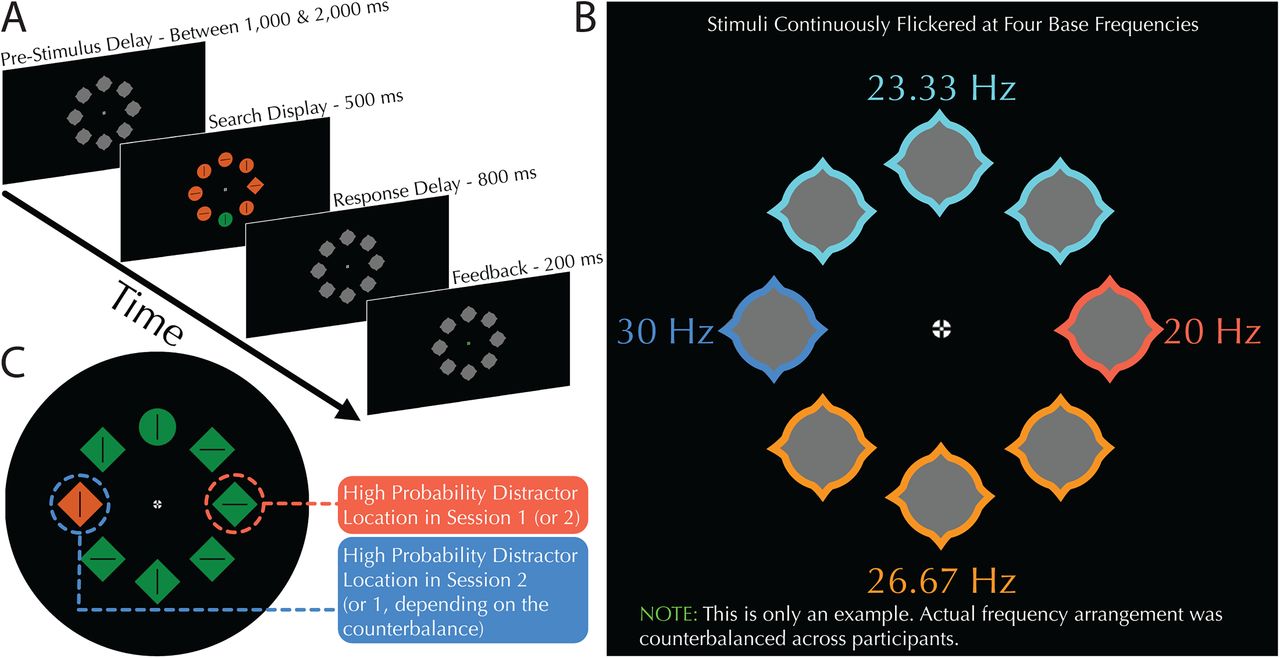
Behavioral paradigm and stimuli. A, Trial breakdown including presentation times of the various screens. Interstimulus intervals were jittered such that they randomly varied between 1,000 and 2,000 ms in duration. Note that search stimuli only appeared at the moment that the four frequencies aligned. Participants were able to respond in a time window of 1,300 ms after search display onset. B, Example of the gray placeholder stimuli with different tagging frequencies represented as different color outlines for illustration that stimuli of the same color flickered at the same frequency (colors were not presented during the experiment). The top three and bottom three stimuli flickered at their own respective frequencies while the far left and far right stimuli had unique frequencies, respectively. The actual distribution of frequencies was counterbalanced across participants such that every combination of the four frequencies was used once in the 24-participant dataset. C, Example search display with high-probability and low-probability location highlighted. Each participant completed two sessions, one with a high-probability distractor location on the right side of the screen and one with it on the left side of the screen (order counterbalanced). Response times tagged responses and ERPs were all restricted to trials in which distractors or targets appeared at these two horizontal locations.


