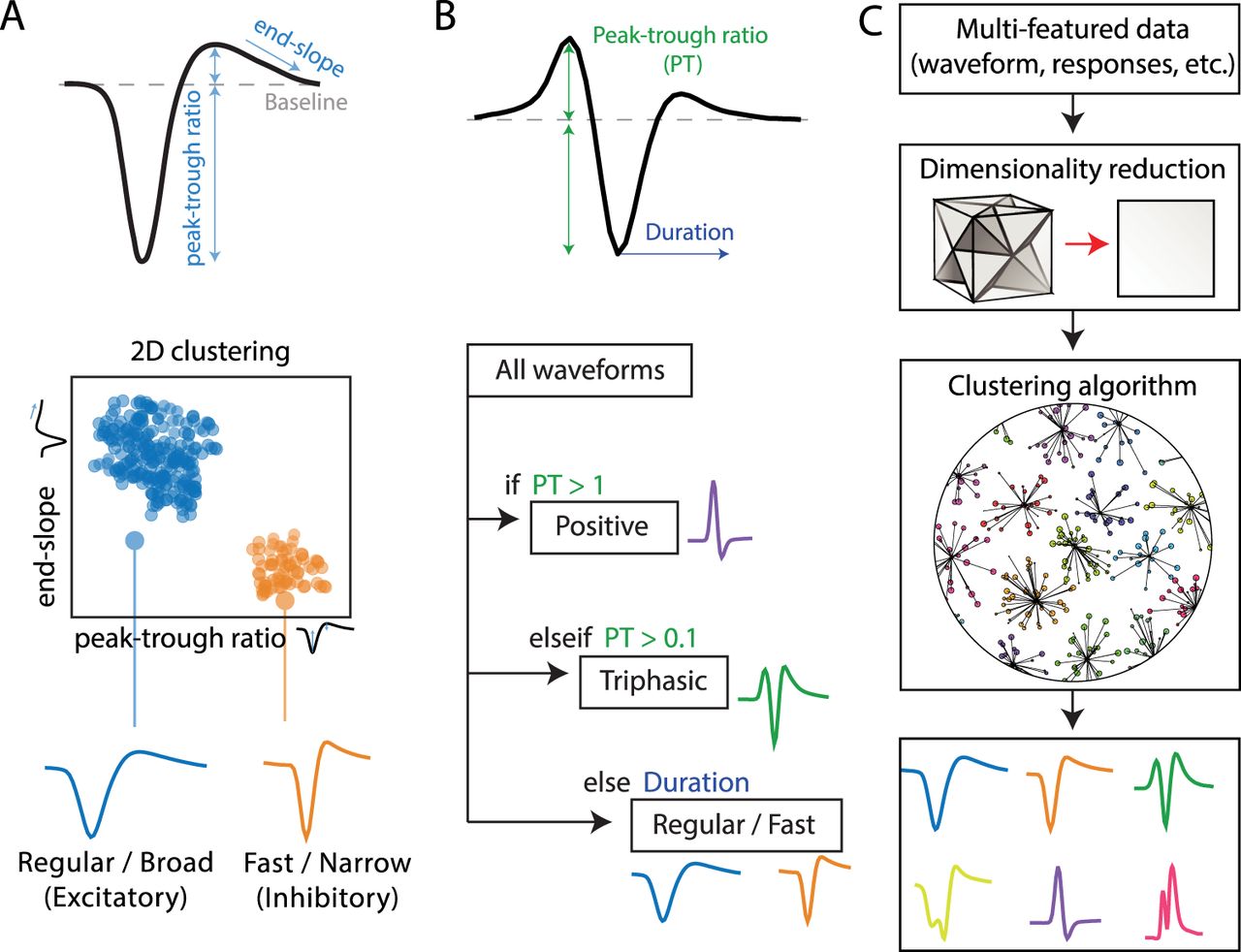
Schematics of common waveform classification techniques. A, Negative waveform classification involves identifying two key features (top inset), projecting them into a 2D feature space (middle inset), and clustering them into regular/broad (blue) and fast/narrow (orange) categories (bottom inset). B, Decision-tree classification. This process also uses traditional waveform features to filter out waveform types in a step-by-step process (like conditional statements). In this example illustration, waveforms with a larger peak than trough are positive, then waveforms with a peak-to-trough ratio >0.1 are triphasic, and then the remaining can be split into regular and fast based on their duration. C, Automated clustering algorithms can explore nuanced waveform types. An example automatic clustering pipeline includes dimensionality reduction of spike waveforms (e.g., principal components analysis), processing through a clustering algorithm (e.g., graph-based clustering or shared nearest neighbor), and sorting into waveform groups.


